The Providence Tax Line That Decides Whether Your Triple-Decker Cash-Flows
September 3, 2026
September 3, 2026
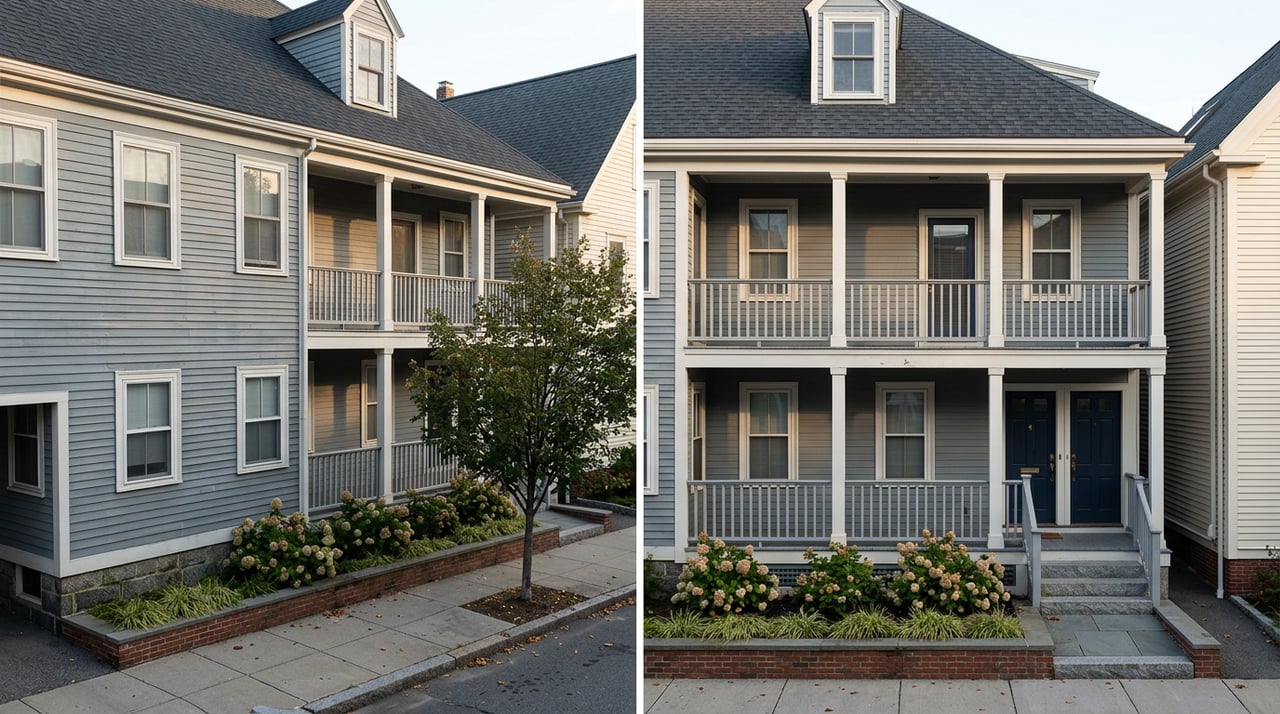
Two triple-deckers, four blocks apart. Same price. Same three units, same rent roll, same year built. A buyer comparing them on paper would call it a toss-up. Then the tax bill arrives, and one building costs several thousand dollars a year more to carry than the other, even though nothing about the structure changed.
The difference isn't the neighborhood. It isn't the roof or the boiler. It's a box the buyer checks on the assessment form: whether the owner lives in one of the units or not.
Providence taxes residential 2 to 5 family property at two different rates depending on occupancy. For fiscal year 2026, an owner-occupied 2-5 family property is taxed at $7.55 per $1,000 of assessed value. A non-owner-occupied 2-5 family property, meaning the owner doesn't live in any unit, is taxed at $14.00 per $1,000. That's nearly double.
Run the math on a triple-decker assessed at $500,000, a realistic figure for the kind of building trading hands in neighborhoods like Elmwood or Silver Lake. Owner-occupied, the annual tax bill comes to $3,775. Non-owner-occupied, it's $7,000. That's a swing of roughly $270 a month before a single dollar of rent, insurance, or maintenance enters the spreadsheet.
| Classification | FY2026 Rate (per $1,000 assessed) | Annual Tax on $500,000 Assessed Value |
|---|---|---|
| Owner-occupied 2-5 family | $7.55 | $3,775 |
| Non-owner-occupied 2-5 family | $14.00 | $7,000 |
That gap doesn't show up on a listing sheet. It shows up on the assessor's card, and it changes which buyer can actually make a given building work.
Buyers comparing Providence to nearby cities usually reach for a simple ratio: annual rent divided by price. By that measure, Providence has looked like the strongest play in the immediate metro, with a rough rent-to-value ratio around 6.1 percent compared to about 5.8 percent in East Providence, 5.6 percent in Pawtucket, and 5.2 percent in North Providence, based on recent rent and value data. Providence wins that comparison on paper.
But that ratio treats every dollar of assessed value the same, and Providence doesn't. A 6.1 percent gross yield calculated at the owner-occupied tax rate is a different deal than the same 6.1 percent calculated at the non-owner-occupied rate. The city-to-city comparison that buyers use to shortlist neighborhoods is built on an assumption that doesn't hold once you're comparing two purchase strategies inside the same city.
This is the part that gets missed. The interesting comparison isn't Providence versus Pawtucket. It's owner-occupant versus investor, on the exact same Providence building.
Walk through a few real categories of listings currently circulating in Providence's multifamily market and the pattern holds.
A three-family in the Elmwood Historic District, roughly 4,100 square feet with ten bedrooms across three units, reads as a strong investment listing regardless of buyer type. But an owner-occupant who moves into one unit and rents the other two locks in the $7.55 rate on the whole assessment. An investor buying the identical building to hold as a rental locks in $14.00. Same rent roll, same neighborhood, structurally different carrying cost.
The same split shows up in Silver Lake and the adjoining West End, where three-family and two-family stock is common and priced for cash flow. It shows up on the East Side too, in properties positioned between Wayland Square and College Hill, where two-family homes marketed as owner-occupant opportunities carry that framing for a reason: the tax math genuinely favors the buyer who lives there. And it shows up in Mount Hope and Wanskuck, both areas where two-family homes get pitched to buyers who might occupy one unit and rent the other, precisely because that structure is what makes the numbers work.
None of this means investment-only purchases don't pencil in Providence. It means the buyer who assumes a triple-decker's tax bill will look the way a rent roll or a national cap rate benchmark suggests is working from an incomplete number. The classification isn't a footnote. It's often the difference between a deal that clears the bar and one that doesn't.
A second lever moved this year, and it changes what a buyer can do with a Providence multifamily property after closing, not just how it's taxed.
As of June 23, 2026, Rhode Island zoning ordinances can no longer require more than one off-street parking space per dwelling unit in multi-family developments located near designated public mobility corridors and transit hubs, under a change to the state's land use statute. Providence's dense RIPTA bus network means a large share of the city's triple-decker stock sits inside that radius.
For a buyer weighing whether to add a unit or convert underused space, the parking requirement was often the constraint that killed the plan before the math even got a chance to work. That constraint just got smaller across much of Providence.
That pairs with Providence's existing accessory dwelling unit framework, formalized in a public guide the city released to help residents navigate the state's ADU rules. Under that guide, a studio or one-bedroom ADU can run up to 900 square feet and a two-bedroom up to 1,200 square feet, with a defined process for separate and internal unit types. Combine a lighter parking requirement with the ADU pathway and a buyer evaluating a two-family in Wanskuck or a triple-decker in Elmwood has more room to add income-producing square footage than they would have had a year ago. That doesn't erase the tax classification gap. It does mean the investor side of the equation has a new tool to close it.
Two practical details are worth confirming before a Providence multifamily closing, regardless of how the tax math works out.
Neither of these changes the purchase decision on its own. Both are the kind of detail that turns into a surprise in month two of ownership if nobody flagged it in month one.
Does buying as an owner-occupant guarantee the lower tax rate for as long as I own the building? The lower rate applies to the owner-occupied classification, which reflects how the property is actually being used. If your occupancy changes down the road, it's worth confirming with the tax assessor's office how and when that would affect your rate, since this is exactly the kind of detail that's specific to your situation and worth a direct conversation with the city.
Does the owner-occupied versus non-owner-occupied split apply the same way to a two-family as it does to a four- or five-family? Yes. The classification covers residential properties from 2 to 5 units, so a two-family house-hack and a five-unit building are both subject to the same rate structure based on occupancy.
If the parking rule changed, does that mean I can add a unit to any Providence multifamily property without a variance? Not automatically. The June 2026 change addresses parking minimums specifically for multi-family development near transit corridors. Adding a unit still involves zoning review, building permits, and confirming your specific lot and structure meet current requirements, so the parking change removes one common obstacle rather than every obstacle.
If you're comparing Providence properties across Elmwood, Silver Lake, the East Side, or anywhere else on the map and want to see how the owner-occupied math actually compares to a straight investment purchase on a specific building, that's a conversation worth having before you write an offer, not after. Lorraine Perri works with buyers across Providence and the surrounding Rhode Island communities on exactly this kind of comparison, from the neighborhood-level guide for Providence to a straightforward home valuation if you're weighing a sale alongside a purchase. Let's Connect and run the real numbers on the building you're actually considering.
Stay up to date on the latest real estate trends.

Connect with a real estate professional who values trust, insight, and personal attention. Every step is guided by a deep understanding of what “home” truly means.